Category: Manufacturing

  • [SOLVED] SRFPROG.exe sometimes stuck or crashed

    You might have experienced this same issue, presented on e2e.ti.com forum, but TI has “locked” my thread without answer. Here’s how to solve that for a very fast and reliable flashing usable in production.

    We are trying to use srfprog.exe to flash the CC2640R2F, and it gets stuck very often, on any step or any argument, under Win-10 64, and using the JTAG from LaunchXL-CC2640R2. Note that SmartRF Flash Programmer 2 also gets stuck or crashes sometimes. I believe for the same reason.

    This, for example, is an output of srfprog where it got stuck and never returned:

    srfprog -ls auto
    
    Texas Instruments SmartRF Flash Programmer 2 v1.7.5-windows
    -------------------------------------------------------------------------------
    

    … stuck here.

    Here is the solution that has been proven to get srfprog.exe to work reliably without crashing for flashing TI’s CC2640 BLE chip family:

    • Wrap the srfprog calls into another program. Let’s call this wrapper srfwrap.
    • srfwrap will detect output activity from srfprog.exe .
    • If srfprog.exe is doing it’s job, it just goes on.
    • If srfprog.exe crashes or gets stuck, srfwrap will kill srfprog and restart the last command. Until it is successfully done.
    • Using this technique, I have been able to reliably program CC2640R2F in production.
    • Combined with other tools, programming the CC2640R2F can be as fast as under 40 seconds per chip, including the MAC address, a Serial Number, and securely locking the JTAG for unwanted access.

    I hope this helps, let me know in the comments 🙂

    Jerome
  • The Popcorn Effect on MSL 1

    The Popcorn Effect on MSL 1

    A little break in Firmware development to help my client, an IoT start-up, diagnosing The Popcorn Effect. Something I’ve never seen with my own eyes before. The Popcorn Effect is a direct consequence of Moisture entering the IC before the reflow process. A common problem in Electronics Manufacturing.

    Production and Testing

    It all started on the assembly line, the IoT product is a kind of thermometer. The production has just started and the first pieces have arrived, ready for testing. One of the test consists of heating the thermometer up to 95°C, repeated 3 Times. It all worked fine up to 40°C when suddenly the software indicated 0°C for 9 of the devices. You would think they all worked fine until they reached that temperature. Some even recovered when cooling down.

    Inspection

    A first visual inspection of the PCBA by microscope doesn’t show any defect, all components are populated properly.

    Measuring the power supplies: it seems like it’s all fine.

    The sensor

    The temperature sensor is the TI TMP-100-Q1, connected to the host controller via I²C.

    Next step, how does the I²C CLK and DATA look like?

    They both look fine, except the data is always HIGH. So returning 0xFFFF to the app which represents -0.0625°C and then displays the nearest integer, 0°C.

    A closer look

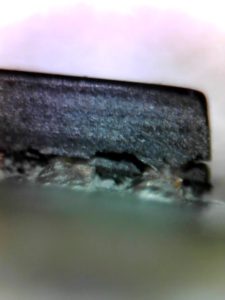
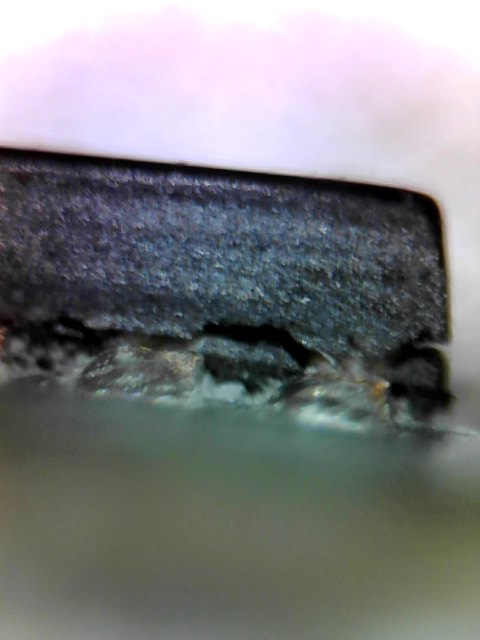
    A closer look with the microscope and yes, here we go. The IC is cracked at its base. Some chips present a slight crack between 2 pins, others show a very clear crack around the corner.

    The Popcorn Effect

    Because moisture found it’s way into the package and expanded in the reflow process, the IC pops like a popcorn.

    Manufacturers deliver the ICs in a sealed package if they are sensitive to moisture. MSL is the Moisture Sensitivity Level, provided by the manufacturer. This indicates how many hours an IC can be exposed to the ambient air before it needs to be baked to escape the trapped moisture in preparation of the reflow.

    The TI TMP-100-Q1 has an MSL 1, which generally means no particular precautions need to be taken. Despite this, level 1 does specify some limits. This example proves that from the chip production to the PCB reflow in Asia, moisture can affect the production even with a MSL 1 rated chip.

    Consequences

    In our case, most ICs stopped working, some only at higher temperatures, some recovered when cooling down. Imagine how many hours could be spend looking for a software bug on something as sporadic as that!

    Action

    The PCBA manufacturer has been notified of the issue and will cook all of these ICs before reflow. This is a standard process that consists of extracting moisture / drying the ICs for many hours at moderate temperature.

  • Visiting Seeed Studio in Shenzhen, China

    Visiting Seeed Studio in Shenzhen, China

    Seeed Studio LogoWhat is Seeed Studio?

    Seeed Studio is a company that specialized in providing help to makers to bring their hardware ideas to life.

    I am mainly looking for a manufacturer to produce IoT products. But before this, by sending them the design files they can already give me a price estimate for the product. So, we will know what the backer’s price should be for the crowdfunding campaign.

    Seeed Studio’s location

    I had a hard time finding Seeed Studio’s offices, mainly because Google maps is wrong. I used a VPN because it’s blocked but still. The pin is right on the satellite view but at the time of my visit, in Dec 2016, the map view was not aligned! If you can read Chinese just use Baidu Map. Otherwise see bellow.


    Here is the direction in English:

    Tower B 1/F, Shanshui Building, NanshanYungu Innovation Industry Park Liuxian Ave. No. 1183, Nanshan District Shenzhen ,Guangdong P.R.C 518055.


    And in Chinese, useful to ask any local or taxi:

    深圳市南山区留仙大道1183号南山云谷创新产业园山水楼1楼B

    Here are the directions to reach Seeed Studio by metro, it’s pretty easy once you know:

    • Get on Shenzhen’s metro line 5.
    • Get off at university town exit B.
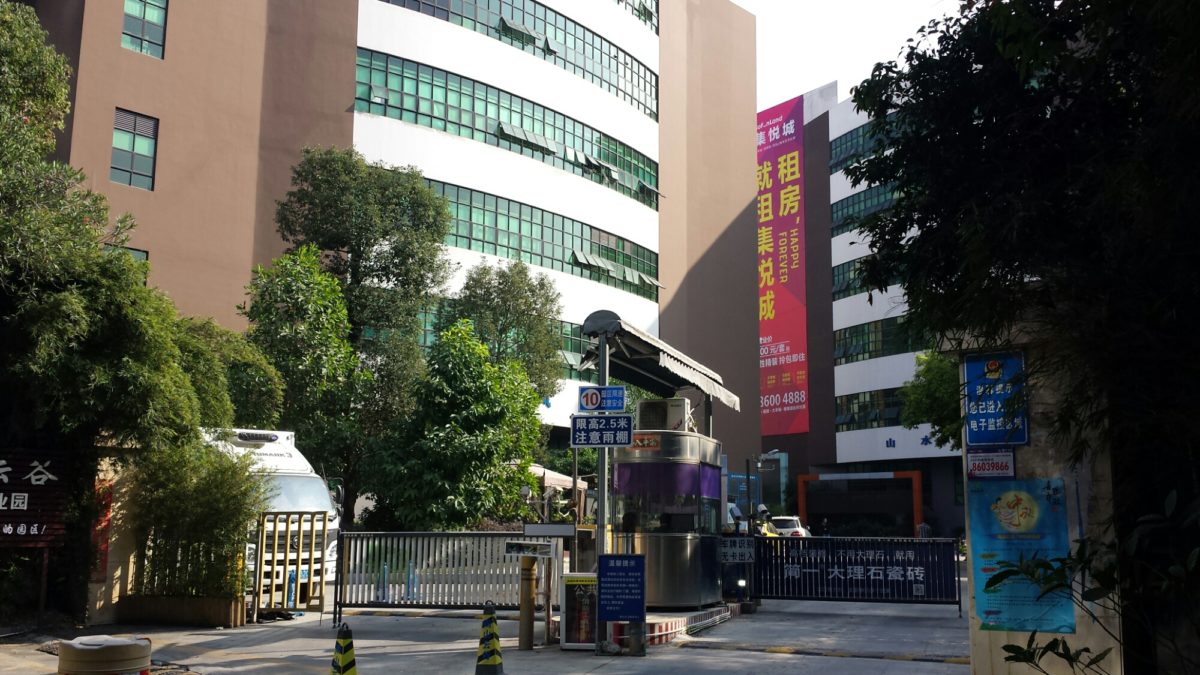
    • Walk straight until you reach this entrance:
    • Seeed Studio’s building IS NOT A TOWER! Pass on the left of the fountain and follow the building at your right, the entrance will be towards the end to your right.

    Seeed Studio’s services.

    Seeed is a hardware innovation platform for makers to grow inspirations into differentiating products. By working closely with technology providers of all scale, Seeed provides accessible technologies with quality, speed and supply chain knowledge. When prototypes are ready to iterate, Seeed helps productize 1 to 1,000 pcs using in-house engineering, supply chain management and agile manufacture forces. Seeed also team up with incubators, Chinese tech ecosystem, investors and distribution channels to portal Maker startups beyond.

    seeedstudio.com, Dec 2016.


    Of course I am concerned by sending them the design files. They are happy to sign an NDA but China is just so famous for copying everything, can we trust them? I don’t know but it seems like a lot of people have already trusted them.