Category: Hardware

  • Finding Electronic parts in Chiang Mai, Thailand 

    Finding Electronic parts in Chiang Mai, Thailand 

    Chiang Mai is a great place for Digital Nomad makers. There is one issue; If you are asking yourself “where can I buy electronic parts in Chiang Mai?”, this post might help you. Thailand is nothing like Shenzhen in China. So, where to find parts, raw components for makers and repairs?

    North Gate, Chiang Mai
    North Gate, Chiang Mai

    Through holes traditional electronics and breadboards

    The tiny shop near North Gate. Map.

    More traditional electronics, power supplies, boxes and kits

    The electronics shop on the North Road.

    North West corner, Chiang Mai
    North West corner, Chiang Mai

    Basic computer related things

    IT malls like Computer Plaza, North East corner.

    Adafruit and Arduino stuff

    Try your chance with Makerspace Thai. Situated in the old town, near Thae Phae Gate, this is a great place for makers.

    SMT and Anything else

    Non usual or SMT components: I’ve been cycling around a lot and there’s no miracle. You have to order online. There are sellers in Bangkok and it’ll take a few days but their websites are in Thai. Or buy on any usual online store. That’s what local professional do, they order on Aliexpress! And it’s cheaper too.

  • Cypress PSoC Review

    Cypress PSoC Review

    Five months have gone since I first started with Cypress, I have now had the chance to try different aspects of their tools on a personal IoT project. Time do do a Cypress PSoC review.

    Was Cypress a good choice for the IoT project? 

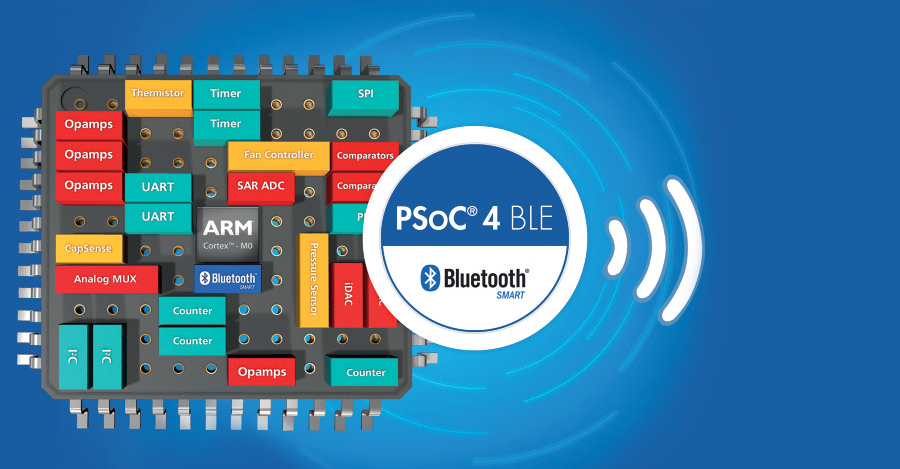
    Cypress’s PSoC 4 family is great I believe, the devices are powerful and enable unlimited possibilities for integrated IoT with the System On Chip. Fewer discreet components means fewer manufacturing problems and cheaper too. Changing the system is as easy as updating the firmware.

    There is one problem that seems to come back every day on forums. That is the system’s complexity. Cypress has tried to addressed this by providing tools, IDE, configuration via schematics design and components, videos, tutos, forums and actually responsive customer service. Some very basic questions on the core’s documentation are unfortunately yet to be addressed. For example, I was asking the following question:

    If I want to add a 10ms delay, how can I find the function that does this?

    We all expect something like:

    Delay_ms(10);

    Yet the function is:

    CyDelay(10);

    Now, where is the documentation, what parameters does this function take?

    Answer from Cypress:

    Let me think about the question.

    We are now a few months later and I’m still waiting for the answer.

    The IDE

    It’s only now that I look at Cypress’s IDE that I realised how great and awesome Atmel Studio is.

    I won’t list the issues here but don’t expect anything user friendly.

    Nevertheless, they do offer a button to export the project to Eclipse [and others], I have tried this but importing it to Eclipse has never worked.

    Was PSoC 4 BLE a good microcontroller choice for the IoT project ? 

    In a previous post I described the way that led me to the Cypress PSoC 4 BLE controller for my IoT device.

    Due to some lack of clear information on their website it was pretty difficult to understand the product road map. I initially choose the PSoC 4 BLE because it is powerful, but it turns out the certified Bluetooth module Cyble-012011-00 has for controller a PRoC, Programable Radio on Chip. This information was not so obvious to find. It is essentially the same chip, minus the programmable analogue components. The good thing is that the effects are minor to none, I did not plan to use the analogue part in my first IoT project anyway. The PRoC is naturally cheaper than the PSoC 4 BLE. It has some limitations on the pin mapping which I didn’t expect but this had no effect too.

    The specs

    What I’ve noticed later is that the power consumption is more important than their competitors, and the analogue routing is limited and finally less flexible than some conventional MCUs. The analogue does however work like a real circuit, without clock at all.

    Should You Be Using Cypress For Your IoT Project? 

    First, don’t be scared. If you have time just take it easy you will learn. If you don’t know much about SoCs it might be hard according to forum members. I’ve had the chance to work multiple times with Altera’s Cyclone at university. So I did learn VHDL, but you don’t need it to start as Cypress has perfectly hidden away the VHDL behind the scenes (components)!

    The good thing is that once you have got something running you just improve it as you go.

    For sure, as advertised, getting started is super easy!

  • Choosing the right IoT Controller 

    Choosing the right IoT Controller 

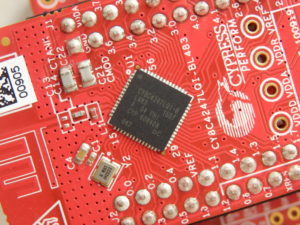
    detail of Cypress PSoC 4 BLE on CY8C4247LQI-BL483
    Cypress PSoC 4 BLE

    To choose the right controller for my IoT idea I start by listing the requirements. Some are essential others just nice to have. The controller is the brain of the system. All performances will depend on it so choosing the right device is essential. It is best to make this choice early to avoid a PCB redesign, rewritting the code, changing the specs.

    Essential requirements

    • Low sleep energy. Several weeks on battery, this implies different following choices.
    • Using Bluetooth Low Energy. This is a very common wireless connection present on most smartphones.
    • BLE certified module, worldwide, because the the low production volume would wouldn’t allow us paying for the certifications.
    • OTA firmware update. This could also be achieved with an external flash.
    • On chip user flash for parameter storage.
    • Capacitive touch sensor controller.
    • Lowest cost.
    • Several GPIOs for peripherals.
    • Easy starter kit to confirm my IoT idea is actually working before going any further.

    Nice to have

    • Battery level measurement.
    • On chip voltage regulator.
    • NFC, for easy pairing
    • For faster time-to-market, it is best to stay with a manufacturer or tools we already have experience with. In my case this was Atmel, Freescale, Microchip, Altera and more generally the ARM Cortex M0 and M4. Howewer, this project is part of my portfolio; I do not mind learning to use new tools and gaining new experience with an unknown manufacturer. In such case, there should be enough material and examples to get us started quickly.

    The candidates

    The following candidates were considered as they were available in July 2016. The market is evolving so there might be something more suitable now.

    • Cypress PRoC/PSoC 4 BLE. Flash 256k.
    • Nordic nRF52832. ADC 12bit 200ksps+ comparator wake up 0.3uA. Flash 256/512. Ram 32/64.
    • ATMEL SAM-B11.
    • Microchip MCP IS1871. BLE4.2.
    • Espressif ESP32.

    My IoT controller choice 

    I was looking for a module with integrated support for capacitive touch sensing. This was not available on Nordic, Atmel, Microchip and Espressif, leaving me with Cypress as only option. To keep a broader choice I looked into external touch sensor controller such as the Microchip CAP1203.

    Once you have selected the candidates it gets down to personal feelings. I’ve worked with the broad Microchip family, then went on Freescale for a few years. As an Ex-Atmel employee I know their products fairly well and some of them in very intimate details. Atmel has achieved the lowest current consumption on ARM. The development environment Atmel Studio is very mature, simple yet advanced using plugins. But this does not mean I’ll stick to something just because I know it well. Who knows me know that the reality is opposite; I like to explore, to discover, to learn, to setup new goals, new challenges.

    Cypress Cyble-012011-00
    Cypress Cyble-012011-00, a PRoC BLE module

    That’s how I choose the Cypress PSoC 4 for the following reasons :

    • Meets all the mandatory criteria.
      • Low sleep energy.
      • Bluetooth Low Energy.
      • BLE certified module available, royalty-free tested Bluetooth IP included.
      • On chip user flash.
      • Proximity sensor.
      • Enough GPIOs.
      • Starter kit CYBLE-CY8CKIT-BLE for quick feasibility check and development.
    • The Cypress PSoC 4 BLE is a very powerful device. I believe that acquiring experience with this ARM based controllers will open new opportunities.
    • Cypress has released the family over a year ago, which means it’s up and running. There’s ample material available, online video, 1o1 lessons, forums and customer service.

    I’ll write a separate post with my feedback with Cypress PSOC 4 BLE after a few months. Was this a good choice?

  • Working at Makerspace Thailand in Chiang Mai 

    Working at Makerspace Thailand in Chiang Mai 

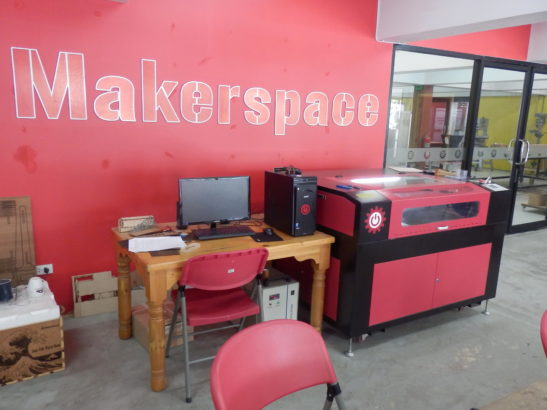
    Makerspace Chiang Mai, Thailand
    Laser cutter at Makerspace Thai in Chiang Mai

    For the purposes of my IoT project, I was looking for a makerspace that would allow me to make my IoT prototype. Also called hackerspace, fablad, fabcafé,… some only have basic equipment like a 3D printer and a soldering iron. When it comes to more advanced electronics such as an oscilloscope or SMT reflow facilities there is not so much left. Let’s have a look at Makerspace Thai.

    Why I choose Chiang Mai’s Makerspace Thai

    Makerspace Thailand
    Makerspace Thailand’s 3D Printers

    I have contacted Nati, the owner of Makerspace Thai, on their Facebook page. He was more than happy to help building a toaster reflow oven for SMT prototyping. So I decided to move to Chiang Mai, certainly the home of the biggest digital nomad community in the world, for a month to build the IoT prototype. They also have a temperature controlled solder iron, a hot air soldering station and a basic oscilloscope too.

    And that’s just about electronics, now add a big laser cutter, at least four 3D printers, two CNCs, a whole bunch of tools for woodwork as well as AC and good WiFi! But Nati is speaking about much more equipment, let me know on the comments if there’s something new.

    Chiang Mai Taxi Tuk-Tuk
    Taxi and Tuk-Tuk in Chiang Mai

    The makerspace’s surrounding

    Makerspace Thai is located in the heart of the old town, between cafés and stunning Temples, in a small quiet back street and next to Punspace Co-working space. There’s plenty of space to host any project and giant windows to let Chiang Mai’s daily sun come in.
    The makerspace offer different price package depending on the frequency you need, from a single day use to the full-time membership. Check out their website for the updated rates.

    Are you a Digital Nomad maker?

    After a month spent in their space, I can say it out loud, Chiang Mai’s makerspace is the perfect place for Digital Nomad makers! I might meet you there one day 🙂

    If you are around Malaysia there is a similar place. I’ll talk about the Makerspace located at the ground floor of aCat Co-working in Penang, Malaysia in a separate post.

  • From Idea to IoT

    From Idea to IoT

    Internet of things (IOT) concept
    Licensed from: onephoto / yayimages.com

    Hello World!

    I’m Jérôme, a French electronics and embedded software engineer. I am usually working as an employee or now as a freelancer, or contractor. But there is a challenge I really want do: Bring my own IoT idea to life!

    IoT stands for internet of things. It’s a name to speak about things that interact to each other rather than to humans.

    I will share this journey with you, I am not yet sure about the content but I can imagine there will be tips, things I learned on the way, etc.

    While creating my own my own IoT product from scratch is already a challenge, I’ll add to this one more level of difficulty: I’m a Digital Nomad.

    What’s that, a Digital Nomad?


    We call Digital Nomad anyone travelling or regularly changing location while working online. Online refers to anything on the computer, digital, not-material, easy to carry around. This typically includes web or software development, design, marketing,… but there is no limit.

    Doesn’t electronics involve hardware? 

    Yes it does, and that’s certainly the major challenge in this project; working with hardware while being on the road. This will naturally lead me to finding ways around the hardware problem, how to avoid carrying an oscilloscope with me on my travels 🙂

    Why are you doing something crazy? 

    I could simply get a job, work in electronics development or as a freelance embedded software developer in one city. I’m still getting multiple offers every day for “fixed location jobs”. I could change for web or software development as I have experience in this too.

    However… I love electronics, I love travelling and I love challenges. I did try to find a remote work contract on Upwork.com but while waiting for the prefect offer it just happened that I started my own project. Let’s see how it goes 🙂