Category: Digital Nomad

  • PCB design with Altium Circuit Studio. FAIL.

    PCB design with Altium Circuit Studio. FAIL.

    Altium Circuit Studio sold by Element14 (Farnell) is a stripped down and cheaper version of the famous Altium Designer.

    I thought I’ll give it a try as they just reduced the price to about 1000$. This makes it competitive with others in the same feature and price range.

    I installed the 30 days trial and started to design the schematic of my IoT project. I have used Altium Designer and even Protel during my studies so not so difficult to remember basic usage.

    I quickly noticed a lot of bugs, crashes and very bad user experience (UX). It finally went to a point that the whole software became unusable due to constant crashes.

    I reported a rather long list of issues that was left without answer. Until another user raised the same major issue on the Element14’s forum: the minimal screen resolution shall be at least 1280 x 1024. Following my complain they finally got in touch but the conclusion is pretty deceiving for Digital Nomads using an ultra portable:

    For any customers using lower res laptops, they get around this limitation by using sw that allows scrolling of the screen. I know it is not the answer the customer is looking for but we do appreciate the candid feedback.

    Altium via Farnell, 2016-11-04

    Altium also assured that the crashes are not common but they don’t have a solution. Trying Circuit Studio was a FAIL for me. I wish it would work as it looks nice and I recommend you to try it. I’ll certainly give it another try with a new computer. But for now it led me to go back towards IBF Target3001 which I used to work with when I started my career.

  • Finding Electronic parts in Chiang Mai, Thailand 

    Finding Electronic parts in Chiang Mai, Thailand 

    Chiang Mai is a great place for Digital Nomad makers. There is one issue; If you are asking yourself “where can I buy electronic parts in Chiang Mai?”, this post might help you. Thailand is nothing like Shenzhen in China. So, where to find parts, raw components for makers and repairs?

    North Gate, Chiang Mai
    North Gate, Chiang Mai

    Through holes traditional electronics and breadboards

    The tiny shop near North Gate. Map.

    More traditional electronics, power supplies, boxes and kits

    The electronics shop on the North Road.

    North West corner, Chiang Mai
    North West corner, Chiang Mai

    Basic computer related things

    IT malls like Computer Plaza, North East corner.

    Adafruit and Arduino stuff

    Try your chance with Makerspace Thai. Situated in the old town, near Thae Phae Gate, this is a great place for makers.

    SMT and Anything else

    Non usual or SMT components: I’ve been cycling around a lot and there’s no miracle. You have to order online. There are sellers in Bangkok and it’ll take a few days but their websites are in Thai. Or buy on any usual online store. That’s what local professional do, they order on Aliexpress! And it’s cheaper too.

  • Visiting Penang’s makerspace, Malaysia 

    Visiting Penang’s makerspace, Malaysia 

    During my stay in Malaysia I discovered Penang’s makerspace which looked very promising.

    Location

    @Cat Co-Working and Penang Makerspace
    @Cat Co-Working and Penang Makerspace

    The island is a nice spot to spend some time but don’t expect too much from the beach, it’s small and busy. Malaysia is a Muslim country so you might be the only one wearing a bikini. And finally, expect a lot of traffic on what looks more like a squeezed city than an island. You can feel my thoughts, can’t you 😀

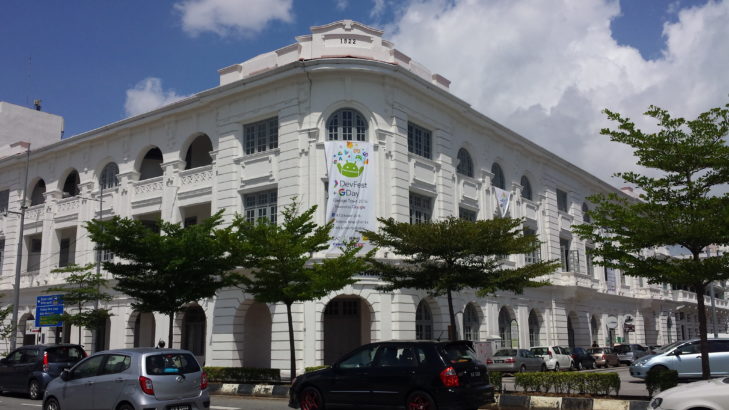
    Penang’s makerspace is situated at the ground floor of @Cat Co-working space, near the Jetty. Map. The enormous colonial building has been freshly renovated. While the Internet connection is very bad on Penang island, this place has an absolutely giant connection speed.

    There’s also a museum and a café, a little over priced but is uses the same good WiFi.

    The place is at the initiative of the Malaysian government who’s intended to do a silicon valley like area. This brought in fundings, investors, donations BUT… that is also a problem. First thing is, workers are public sector employees, and my feeling was like they don’t care about you and me. If you want to know anything you’ll have to ask. If you want to 3D print but THE printer guy is on holiday for a week, well, just come back in a week because the other 10 won’t show you. Secondly there is little flexibility, let me explain :

    Service and Equipment

    In order to bring my Idea to IoT, I was looking for a Makerspace that would allow me to develop a prototype. This involved SMT reflow.

    Because Penang’s makerspace is owned by the government, asking for help in acquiring a missing equipment is difficult. You know, bureaucracy. They actually suggested that I should buy or build and donate the equipment myself.

    There is free basic electronic equipment such as soldering stations. No subscription, just walk in and start making. Awesome.

    For a small membership fee you get access to a very large panel of wood work tools, advanced electronic equipment like spectrum analyser and [to be completed]. And of course the usual 3D printer.

    Taxes

    Window view from @Cat
    Window view from @Cat

    It is also good to note, Penang and surrounding area benefit from tax free importation on electronic parts. This means not paying any custom fees that can be as high as 30% or more.

    Conclusion

    Penang’s public makerspace has a lot of potential, yet what makes it strong is also making it very weak. If you are a Digital Nomad maker you should checkout Makerspace Thailand.

  • Working at Makerspace Thailand in Chiang Mai 

    Working at Makerspace Thailand in Chiang Mai 

    Makerspace Chiang Mai, Thailand
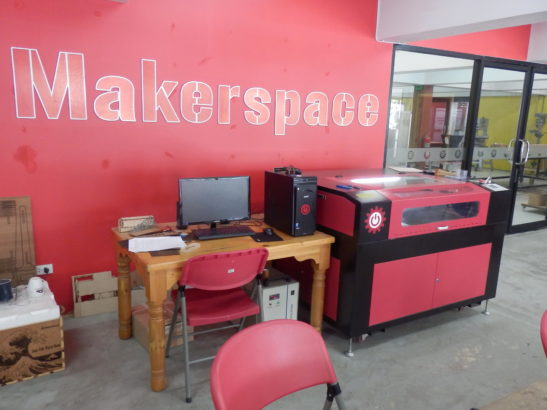
    Laser cutter at Makerspace Thai in Chiang Mai

    For the purposes of my IoT project, I was looking for a makerspace that would allow me to make my IoT prototype. Also called hackerspace, fablad, fabcafé,… some only have basic equipment like a 3D printer and a soldering iron. When it comes to more advanced electronics such as an oscilloscope or SMT reflow facilities there is not so much left. Let’s have a look at Makerspace Thai.

    Why I choose Chiang Mai’s Makerspace Thai

    Makerspace Thailand
    Makerspace Thailand’s 3D Printers

    I have contacted Nati, the owner of Makerspace Thai, on their Facebook page. He was more than happy to help building a toaster reflow oven for SMT prototyping. So I decided to move to Chiang Mai, certainly the home of the biggest digital nomad community in the world, for a month to build the IoT prototype. They also have a temperature controlled solder iron, a hot air soldering station and a basic oscilloscope too.

    And that’s just about electronics, now add a big laser cutter, at least four 3D printers, two CNCs, a whole bunch of tools for woodwork as well as AC and good WiFi! But Nati is speaking about much more equipment, let me know on the comments if there’s something new.

    Chiang Mai Taxi Tuk-Tuk
    Taxi and Tuk-Tuk in Chiang Mai

    The makerspace’s surrounding

    Makerspace Thai is located in the heart of the old town, between cafés and stunning Temples, in a small quiet back street and next to Punspace Co-working space. There’s plenty of space to host any project and giant windows to let Chiang Mai’s daily sun come in.
    The makerspace offer different price package depending on the frequency you need, from a single day use to the full-time membership. Check out their website for the updated rates.

    Are you a Digital Nomad maker?

    After a month spent in their space, I can say it out loud, Chiang Mai’s makerspace is the perfect place for Digital Nomad makers! I might meet you there one day 🙂

    If you are around Malaysia there is a similar place. I’ll talk about the Makerspace located at the ground floor of aCat Co-working in Penang, Malaysia in a separate post.

  • From Idea to IoT

    From Idea to IoT

    Internet of things (IOT) concept
    Licensed from: onephoto / yayimages.com

    Hello World!

    I’m Jérôme, a French electronics and embedded software engineer. I am usually working as an employee or now as a freelancer, or contractor. But there is a challenge I really want do: Bring my own IoT idea to life!

    IoT stands for internet of things. It’s a name to speak about things that interact to each other rather than to humans.

    I will share this journey with you, I am not yet sure about the content but I can imagine there will be tips, things I learned on the way, etc.

    While creating my own my own IoT product from scratch is already a challenge, I’ll add to this one more level of difficulty: I’m a Digital Nomad.

    What’s that, a Digital Nomad?


    We call Digital Nomad anyone travelling or regularly changing location while working online. Online refers to anything on the computer, digital, not-material, easy to carry around. This typically includes web or software development, design, marketing,… but there is no limit.

    Doesn’t electronics involve hardware? 

    Yes it does, and that’s certainly the major challenge in this project; working with hardware while being on the road. This will naturally lead me to finding ways around the hardware problem, how to avoid carrying an oscilloscope with me on my travels 🙂

    Why are you doing something crazy? 

    I could simply get a job, work in electronics development or as a freelance embedded software developer in one city. I’m still getting multiple offers every day for “fixed location jobs”. I could change for web or software development as I have experience in this too.

    However… I love electronics, I love travelling and I love challenges. I did try to find a remote work contract on Upwork.com but while waiting for the prefect offer it just happened that I started my own project. Let’s see how it goes 🙂